
Choosing a Glass Magnesium Rock Wool Sandwich Panel is not simply a price comparison. It is a decision about fire safety, thermal performance, moisture resistance, installation quality, and long-term maintenance. In real construction projects, a panel that looks excellent in a sample room can behave differently on a cold, humid site. Small details matter.
Measure twice.
This guide presents seven practical tips for selecting the right panel with greater confidence. You will learn how to compare core density, panel thickness, surface flatness, joint design, and declared fire performance. Check whether the supplier provides current test reports, product specifications, and installation instructions from recognized laboratories or certification bodies. Do not rely on attractive brochures alone. Verify the actual rock wool density and magnesium board composition supplied for your project.
Site conditions deserve equal attention. A warehouse roof, cleanroom wall, and temporary partition require different performance priorities. Consider temperature changes, condensation risk, impact exposure, acoustic requirements, and the available fixing system. Ask for samples with visible edges and inspect them for cracks, warping, uneven bonding, or weak corners. A cheaper quotation may exclude accessories, sealing materials, transport protection, or professional installation. That mistake can become expensive.
No panel fits every building.
The most reliable choice balances tested performance, supplier transparency, installation support, and total lifecycle cost. These tips will help buyers ask sharper questions, identify hidden risks, and avoid making a decision based only on appearance or initial price.
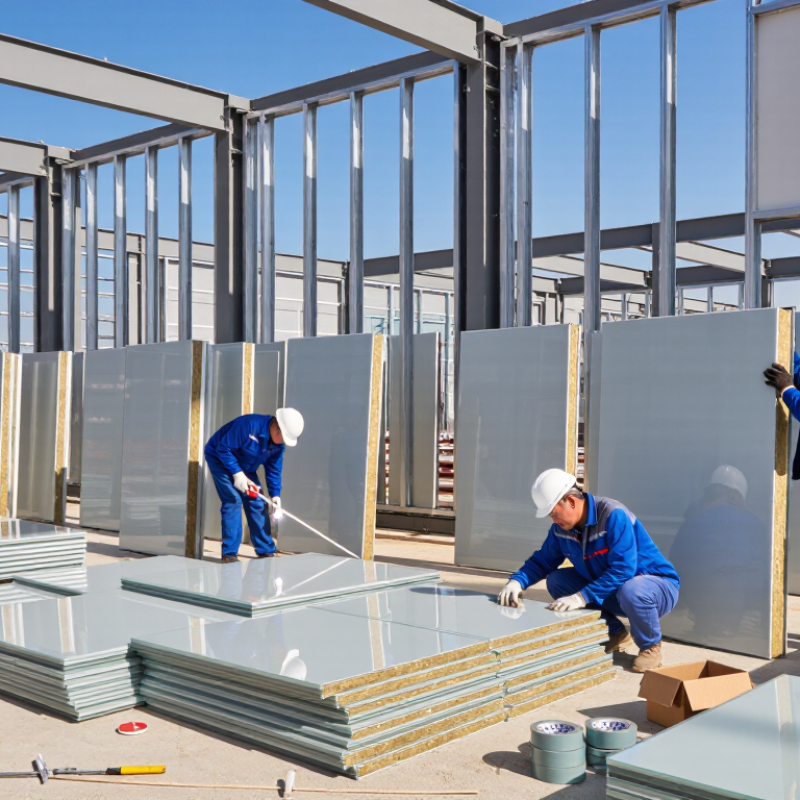
7 Tips for Buying Glass Magnesium Rock Wool Sandwich Panels
Glass magnesium rock wool sandwich panels combine a rigid glass magnesium surface with a mineral wool core. The core density commonly ranges from 80 to 150 kg/m³. This range affects insulation, sound absorption, fire resistance, and panel stiffness. Higher density may improve compression strength, but it does not guarantee better overall performance. Tip 1: Match density with the building’s actual demands. Tip 2: Confirm the core density through a recent laboratory report, not only a supplier’s description.
Tip 3: Check the panel thickness and thermal conductivity together. An 80 kg/m³ core may suit many wall applications, while a 150 kg/m³ core can offer stronger acoustic and structural support. Tip 4: Inspect the glass magnesium surfaces for flatness, edge damage, and moisture marks. Small defects can become installation problems. Tip 5: Ask whether the panel has been tested for fire behavior, water absorption, and dimensional stability. Reliable documents should show test methods and dates.
Tip 6: Review the joint design before ordering. Poorly sealed seams can reduce insulation performance, even with a suitable core. Tip 7: Calculate transport and handling requirements, because dense panels are heavier and need careful lifting. I once treated density as the main buying factor. That was too simple. Facings, adhesives, thickness, and installation quality also matter. Request a sample and measure its weight, thickness, and surface condition before approving a large batch.
| No. | Buying Tip | Key Data Dimension | Practical Specification or Target | Why It Matters | How to Verify |
|---|---|---|---|---|---|
| 1 | Define the panel construction | Panel composition | Two glass magnesium board facings with a bonded rock wool core; the core should be continuous and tightly fitted. | The facings provide surface rigidity and impact resistance, while rock wool provides thermal, acoustic, and fire-related performance. | Request a cross-section drawing, material declaration, and production specification showing the facing and core materials. |
| 2 | Check the rock wool core density | Core density | 80–150 kg/m³; select the value according to the required structural, acoustic, and fire-performance level. | Higher density generally improves rigidity and can support better acoustic performance, but it also increases panel weight and handling requirements. | Compare the declared density with a batch test report. Calculate density from measured dry mass ÷ measured core volume when sampling is permitted. |
| 3 | Match thickness to the application | Overall panel thickness | Common project ranges are approximately 50–150 mm. Select thickness based on thermal, fire, acoustic, and load requirements rather than appearance alone. | Increasing the rock wool thickness generally reduces heat transfer and improves sound absorption, while affecting weight, joints, and installation details. | Confirm the nominal thickness and tolerance on the technical drawing; measure several points across the panel, including the edges. |
| 4 | Evaluate thermal insulation | Thermal conductivity | Rock wool commonly has a declared thermal conductivity around 0.035–0.045 W/(m·K), depending on density, temperature, moisture, and test method. | Thermal conductivity and core thickness determine the approximate thermal resistance of the insulated panel. | Ask for a test or declaration stating the conductivity value, reference temperature, moisture condition, and applicable test standard. |
| 5 | Confirm fire-performance requirements | Reaction to fire and fire resistance | Rock wool is generally non-combustible or of very limited combustibility when tested as a material; the complete sandwich panel classification depends on the facings, adhesive, joints, and assembly. | A core-material claim cannot replace a fire classification for the complete panel system. | Request a current full-panel fire test or classification report for the exact thickness, facing, adhesive, joint, and installation configuration. |
| 6 | Inspect facing-board quality and moisture behavior | Glass magnesium board performance | Check board thickness, flatness, edge integrity, water absorption or dimensional stability data, and compatibility with the intended indoor or sheltered outdoor environment. | Glass magnesium boards can vary by formulation. Moisture exposure, wetting and drying, and unsupported edges may affect long-term performance. | Review the product data sheet, inspect sample edges and surfaces, and verify that the adhesive and joint sealant are compatible with the boards. |
| 7 | Check mechanical performance, joints, and tolerances | Flatness, bond strength, load capacity, and joint design | The required load capacity depends on span, support spacing, wind or service load, panel orientation, and connection details. Use the supplier’s tested values for the exact assembly. | A dense core alone does not define the panel’s allowable span or structural capacity. Poor joints can also reduce thermal, acoustic, and fire performance. | Request load tables, deflection limits, bond or delamination test results, dimensional tolerances, installation drawings, and joint details. |
| Property | Typical Reference Range or Description | Important Qualification |
|---|---|---|
| Rock wool core density | 80–150 kg/m³ | The selected density should be confirmed for the specific panel and tested assembly. |
| Rock wool thermal conductivity | Approximately 0.035–0.045 W/(m·K) | Actual declared values vary with density, temperature, moisture, orientation, and test method. |
| Overall panel thickness | Commonly approximately 50–150 mm | The suitable thickness must be calculated from project requirements and local building regulations. |
| Panel mass | Approximately 10–25 kg/m² for many common configurations | Mass changes with core density, thickness, facing-board thickness, moisture, and accessories; use the declared product value for design. |
| Fire performance | Rock wool is generally non-combustible or of very limited combustibility as a mineral-fibre core. | Complete-panel performance must be established by testing or classification of the exact panel system. |
| Main application considerations | Partition walls, ceilings, clean areas, interior envelopes, and selected protected exterior applications | Exposure, ventilation, impact, hygiene, moisture, and structural conditions must be assessed before selection. |