
Discover Exciting Plastic Manufacturing Jobs at Allied Plastics

How to Choose the Best EV Charger Tester?

Choosing an Ev Charger Tester is not just a matter of comparing prices or counting features. The right instrument should match the chargers you inspect, the connectors you encounter, and the measurements your work requires. A tester used for basic checks may not support simulated vehicle states or advanced fault testing. Small differences matter.

Start with the practical details. Check connector compatibility, supported charging modes, measurement ranges, and whether the device can verify functions such as control-pilot signaling and protective-conductor continuity. Confirm that its safety ratings suit the electrical environment where you plan to use it. Read the manual before relying on any test result. It sounds obvious, but this step is often rushed.

Field conditions matter too. A clear display is useful in a dim garage, while durable leads and a protective case help during repeated site visits. If your work requires recorded results, look for data export and calibration information. Ask whether the tester has traceable calibration documentation, and confirm what accessories are included. Not every feature earns its cost.

This guide compares the main selection factors, from essential checks to specialized capabilities. It also explains which specifications deserve close attention and which may be unnecessary for your setup. There is no perfect tester for every technician. A model that looks impressive on paper can still feel awkward in daily use. Consider your actual workflow, verify claims against the manufacturer’s documentation, and leave room to reconsider after hands-on testing. That judgment takes experience.
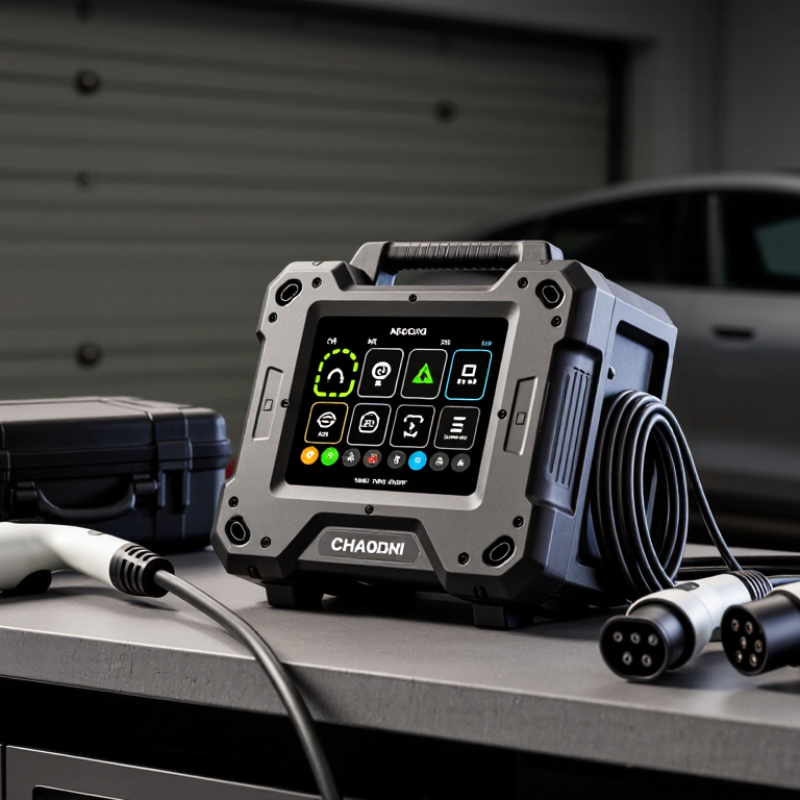
How to Choose the Best EV Charger Tester?

What an EV Charger Tester Measures and Why It Matters

How to Choose the Best EV Charger Tester?

What an EV Charger Tester Measures and Why It Matters

An EV charger tester checks whether a charging point communicates and operates safely. Depending on the model, it can measure voltage, confirm protective-earth continuity, and simulate a vehicle’s connection through control-pilot signals. Some testers also check residual-current protection or verify charging current. These checks reveal faults that a simple “ready” light may miss. Small faults matter.

The scale of charging makes reliable checks increasingly important. The International Energy Agency’s Global EV Outlook 2024 reported nearly 14 million electric cars sold worldwide in 2023, about 18% of all car sales. The same report found public charging points grew by more than 40% that year. More equipment means more installations to inspect and maintain.

A useful tester should show clear readings, support the connector type being checked, and document results consistently. For example, a technician can verify a simulated vehicle connection before investigating why a charger will not start. A tester does not prove every real-world condition is safe. A clean screen can still create false confidence if the test procedure misses a fault. Use equipment with appropriate ratings, follow its instructions, and have qualified personnel interpret results. IEA figures describe market growth, not a guarantee that any individual charger works correctly.

Which Charger Types and Connectors Must It Support?

A useful EV charger tester should match the charging equipment you actually inspect, not just the most common plug in your area. Check whether it supports AC charging, DC fast charging, or both. AC testing often involves Type 1 or Type 2 connectors, while DC systems may use CCS1, CCS2, CHAdeMO, or GB/T. Connector availability varies by region and vehicle.

Check the tester’s physical inlets and included adapters against the charger cable and vehicle interface. A plug that fits is not enough. The tester must also handle the relevant control and proximity signals, and its voltage and current ratings must suit the equipment. For example, a compact AC tester may be unsuitable for a high-voltage DC station.

Small detail. Big consequence.

Consider the jobs you perform most often: installation checks, fault diagnosis, or routine maintenance. A tester designed for one connector family may need additional adapters for mixed fleets. Adapters can add setup steps, and they do not always reproduce every test condition. That is easy to overlook. Before buying, compare the supported connector list with the actual chargers and vehicles you service, then verify the tester’s operating limits in its documentation.

How to Compare Testing Functions, Accuracy, and Ease of Use

When comparing EV charger testers, check what they actually exercise: control-pilot states, cable coding, protective-earth continuity, and residual-current protection. IEC 61851 defines charging-system communication requirements, while IEC 62752 covers in-cable control and protection devices. A tester that simulates only a charging state may miss important safety checks. Small details matter.

Accuracy deserves more than a large number on a specification sheet. Look for stated measurement ranges, uncertainty, and calibration information, then check that these suit the readings you need to verify. For example, confirm whether the instrument measures voltage, loop impedance, and RCD trip behavior, or only indicates pass and fail. Not just numbers. The IEA’s Global EV Outlook 2024 reports that public charging points worldwide grew by about 40% in 2023, reaching roughly four million. That expansion makes repeatable commissioning and fault checks increasingly important.

Ease of use becomes clear at the charger, not in a brochure. Can you select a test sequence with gloves on, read the screen in bright daylight, and save results with a site identifier? Check whether adapters and leads are clearly labeled, too. A common buying mistake is overvaluing feature count; extra menus can slow routine work. I may still miss a useful function on a quick demo, so test the workflow on a representative charger before choosing.

What Safety Standards and Protection Features Should You Check?

How to Choose the Best EV Charger Tester?

What Safety Standards and Protection Features Should You Check?

A dependable EV charger tester should match the electrical hazards it may encounter. Check its measurement category and voltage rating against the installation and test location; a higher number alone does not guarantee suitability. Look for clear references to relevant standards, such as IEC 61851 for conductive charging equipment and IEC 61010 for measurement safety. Requirements vary by region, so verify local guidance rather than relying on a label alone.

Protection details matter during real testing. Insulated leads, finger guards, secure connectors, and overload protection help reduce exposure to live parts. For residual-current device checks, confirm the tester supports the protection types required by the charging system. Useful functions may include protective-earth continuity checks, simulated control-pilot states, and fault-condition testing. These features help reveal problems before a vehicle is connected. Small details count.

Check the enclosure rating if the tester will be used outdoors, where rain, dust, or grit can reach the socket. Review the manual for safe connection steps, warning indicators, and limits on test duration. Calibration records and traceable results also support consistent measurements over time. I still inspect leads for cuts and loose strain relief before testing; it takes seconds, and it is easy to forget. No tester replaces training or a site-specific risk assessment.

How to Match a Tester to Your Needs and Budget

How to Choose the Best EV Charger Tester?

The right EV charger tester depends on what you need to check, how often you use it, and what you can spend. For occasional home checks, a straightforward unit may be enough to confirm basic charging signals and wiring conditions. A service technician may need a tester that simulates control-pilot states, checks protective functions, and records results. Match its measurement range and connector compatibility to the chargers you actually encounter. Extra features are useful only when they answer a real testing need.

Tips: List your charger types and required checks before comparing prices. Check the tester’s stated limits, calibration guidance, and operating instructions. A cheap unit can cost more later if it cannot perform a necessary test.

Think about the full cost, not just the checkout price. A display that is easy to read outdoors, durable leads, and clear instructions can save time during repeated checks. One easy mistake is buying the most feature-rich tester without confirming that its functions fit your work. I would also avoid treating a tester as proof that every part of a charging installation is safe; measurements have limits, and results depend on correct setup. If a test is unclear, pause and consult the equipment instructions or a qualified technician.

How to Choose the Best EV Charger Tester? — Match a Tester to Your Needs and Budget
Tester Category Typical Budget (USD) Best Suited For Typical Capabilities Important Limitations How to Choose
Basic EVSE simulator or adapter About $100–$300 Basic checks by homeowners, technicians, or small service teams May simulate common control-pilot states, indicate whether an EVSE responds, and provide access for selected electrical measurements. Often provides limited measurements and may not perform a complete installation safety test or RCD test. Choose one only when basic operational checks are sufficient. Confirm connector compatibility and exactly which pilot states and tests are supported.
Dedicated EV charger tester About $300–$800 Installers and service technicians testing charging equipment in the field Common models can simulate vehicle connection and charging states, check control-pilot behavior, and support selected checks for protective conductors and fault responses. Functions vary considerably. Some models require separate instruments for voltage, insulation, continuity, or residual-current-device testing. Compare the test functions against the commissioning procedure and local electrical rules; do not assume every model performs every safety test.
Installation multifunction tester with EVSE accessories About $800–$2,000 or more Electricians who also need broader installation testing Depending on the instrument and accessories, may combine EVSE simulation with electrical checks such as voltage, protective-conductor continuity, insulation resistance, and RCD testing. Accessories may be required for EVSE-specific tests. Confirm that the tester supports the relevant RCD types and test procedures. Consider this option when one instrument must serve both charger commissioning and general installation work.
Advanced diagnostic or power-analysis setup About $2,000 and up Specialist service teams, laboratories, and detailed fault investigations May offer expanded diagnostics, data logging, or power-quality analysis when paired with suitable instruments and probes. Higher cost and complexity; advanced analysis is not necessary for routine installation checks. Buy only when the extra diagnostic detail is part of regular work and staff are trained to interpret the results.
Connector and standard compatibility Check before purchase Anyone testing chargers with more than one connector type or charging system Testers and adapters are available for different charging interfaces, including Type 1 and Type 2 AC equipment. Compatibility depends on the specific model and accessories. A connector adapter does not necessarily provide the correct test functions for every charger or charging mode. Match the tester to the charger’s connector, AC or DC use, and the applicable standards and local requirements.
Safety, calibration, and documentation Include in total ownership cost All professional users Usable results depend on suitable measurement ratings, current calibration where required, correct procedures, and clear test records. A charger simulator alone does not replace a correctly rated electrical safety tester or qualified work practices. Check measurement ratings, calibration arrangements, supplied documentation, and whether results can be recorded for commissioning reports.
Budget figures are approximate USD ranges and vary by region, included accessories, measurement functions, and calibration services. Before buying, verify the manufacturer’s specifications, applicable IEC 61851 requirements, connector compatibility, and local electrical regulations.