Top China Extractive Distillation Column for Industrial Use?
The China Extractive Distillation Column is gaining significant attention in the industrial sector. Experts recognize its vital role in enhancing separation processes. Dr. Li Wei, a leading authority on chemical engineering, states, "The efficiency of China Extractive Distillation Columns can revolutionize the petrochemical industry." His insights highlight the growing importance of this technology.
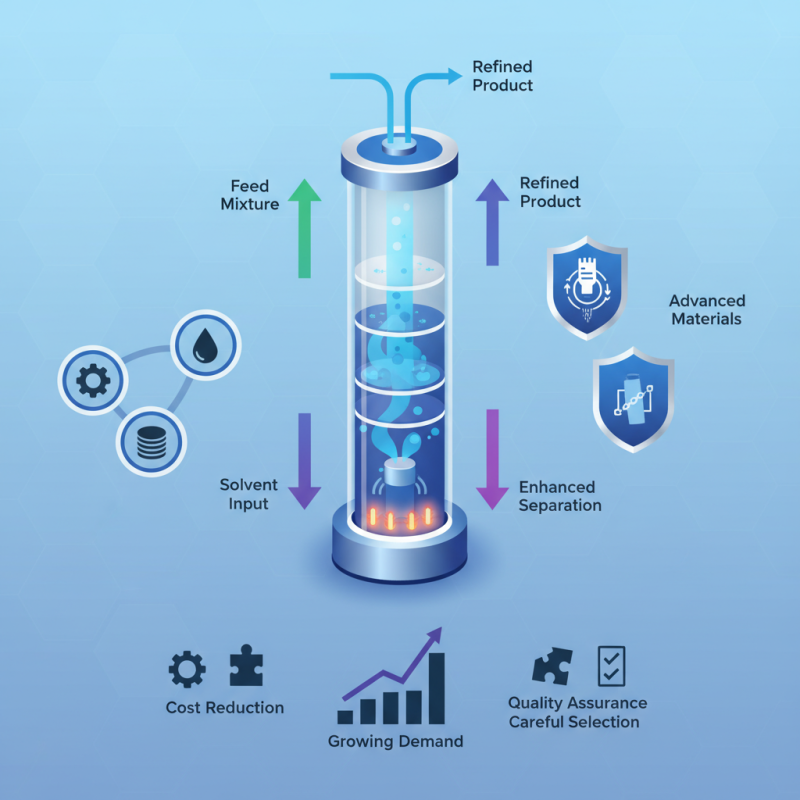
In recent years, the demand for high-efficiency distillation solutions has surged. Industries are seeking innovative methods to improve product purity and reduce costs. The China Extractive Distillation Column offers a solution tailored to these needs. Its design incorporates advanced materials for better heating distribution and enhanced separation.
However, the rapid advancement in this field also poses challenges. Not all manufacturers adhere to the highest standards. Quality assurance remains a concern. Evaluating different providers is essential for end-users. Overall, while the China Extractive Distillation Column shows great promise, careful consideration is necessary to select the best fit for industrial applications.
Overview of Extractive Distillation in Industrial Processes
Extractive distillation is a critical technique in various industrial processes. This method enhances separation efficiency by introducing an additional solvent. It helps in the separation of close-boiling components. Industries utilize this method for higher purity standards. Applications include petrochemical, pharmaceutical, and food processing sectors. The process requires careful selection of solvents. Using the wrong solvent can lead to inefficiencies and increased costs.
One challenge in extractive distillation is balancing solvent recovery and operational costs. Solvent management plays a significant role in overall efficiency. If the solvent is not recycled effectively, it can lead to waste and increased environmental impacts. Moreover, the complexity of the distillation column design poses another difficulty. Operators must ensure optimal conditions for maximum extraction efficiency. This involves constant monitoring and adjustments.
The evolution of extractive distillation also faces technological constraints. Newer methods and solvents are continuously explored. However, the industry often lacks standardized approaches. Each application can require a tailored solution for effective results. Adapting to unique operating conditions is vital for success. Despite its challenges, extractive distillation remains a cornerstone for industrial separation processes.
Top China Extractive Distillation Column for Industrial Use
| Feature | Specification | Applications |
| Column Height | 8-12 meters | Acidic Component Separation |
| Diameter | 0.5-2.5 meters | Solvent Recovery |
| Materials | Stainless Steel, Borosilicate Glass | Chemical Processing |
| Operating Pressure | 0.1-0.5 MPa | Petrochemical Industry |
| Efficiency | 90-95% | Pharmaceuticals |
| Heat Exchange Type | Shell and Tube, Plate | Food Processing |
Key Features of Top China Extractive Distillation Columns
Extractive distillation columns are essential in industrial separation processes. The efficiency of these systems relies heavily on their design and features. A top China extractive distillation column stands out due to its advanced technology and robust materials. These columns typically have a higher capacity, enabling them to handle larger volumes of feed. The precise control of temperature and pressure enhances separation efficiency, ensuring products are closer to the desired purity levels.
Another significant feature is the column's modular design, which allows for easy installation and maintenance. The use of corrosion-resistant materials contributes to longevity, reducing downtime for repairs. However, achieving optimal performance requires careful monitoring. Users often encounter challenges like fluctuating feed quality or unexpected temperature variations. Balancing these factors is crucial for maintaining efficiency.
Investing in a high-quality extractive distillation column can significantly impact production outcomes. The return on investment may take time to materialize. However, the benefits, such as increased yield and reduced waste, reflect the importance of reliable equipment in industrial processes. Regular staff training on operational protocols aids in overcoming potential issues, ensuring that efficiency remains a priority.
Applications of Extractive Distillation in Various Industries
Extractive distillation is a vital process used in various industries to separate complex mixtures. It leverages solvents to enhance separation efficiency. This method finds practical applications primarily in the petrochemical sector, where it improves the distillation of light hydrocarbons. By carefully selecting solvents, industries can better isolate desired components, which might otherwise be difficult to separate due to their similar boiling points.
Another key application lies in the production of high-purity solvents. Chemical manufacturers often need pure solvents for their reactions. Extractive distillation allows these companies to refine solvents to the required purity levels. However, it’s not without its challenges. Choosing the right solvent is critical, and a poor choice can lead to inefficiencies. The process requires a deep understanding of mixture behavior and solvent characteristics.
Pharmaceuticals also benefit from extractive distillation. This technique aids in separating valuable compounds that are crucial for drug production. The increasing demand for pure compounds pushes industries to adopt advanced distillation methods. Still, companies must regularly evaluate and optimize their processes to stay competitive and effective. Balancing purity and operational costs is an ongoing challenge in this field.
Comparative Analysis of Leading Extractive Distillation Technologies
Extractive distillation is a key technique in chemical engineering, especially for separating close-boiling components. To achieve efficient separation, various technologies have been developed. Comparing leading extractive distillation methods reveals significant differences in efficiency, cost, and application.
One prominent technique utilizes solvents that modify volatility. This method often improves separation but may lead to higher operational costs. It also requires careful selection of solvents to prevent unwanted reactions. While this process can provide substantial gains in specific applications, the need for rigorous testing remains crucial. The choice of solvent can impact environmental sustainability and safety.
Another approach employs advanced column designs that enhance mass transfer. These designs aim to reduce energy consumption and improve yield. However, optimizing these systems can involve complex engineering challenges. Variability in feed composition can affect performance, leading to inconsistent results. Monitoring and adapting to these changes is essential for maintaining efficiency.
Future Trends and Innovations in Extractive Distillation Equipment
The extractive distillation sector is experiencing rapid evolution. Innovative technologies are being developed to enhance efficiency and product quality. According to a recent industry report from Market Research Future, the global market for extractive distillation equipment is projected to grow significantly, reaching a value of $3.1 billion by 2025. This growth reflects the increasing demand for separation processes in various industries, such as petrochemicals and pharmaceuticals.
Recent advancements focus on improving energy efficiency and reducing operational costs. For instance, new column designs utilize advanced materials that facilitate better mass transfer. A notable trend is the integration of artificial intelligence in process optimization. AI systems can monitor real-time data, allowing for precise adjustments to maximize output. However, the industry faces environmental challenges. Addressing waste management and emissions remains critical.
The importance of regulatory compliance is undeniable. As industry standards evolve, companies must adapt their technologies to meet regulatory demands. The challenge lies in balancing innovation with adherence to local and international guidelines. Emerging players in the market might struggle to keep pace with these requirements, highlighting the need for strategic partnerships and collaborations.
Trends in Extractive Distillation Equipment Usage (2023)