Discover Exciting Plastic Manufacturing Jobs at Allied Plastics

Top 10 Hydraulic Cylinder Seals Manufacturers Worldwide

Hydraulic Cylinder Seals sit quietly inside excavators, presses, injection machines, and mobile lifting systems. Their work is demanding: they retain fluid, resist pressure, control friction, and protect moving rods from dust and water. A small scoring mark can become leakage, downtime, and an expensive service call. That reality gives this Top 10 Hydraulic Cylinder Seals Manufacturers Worldwide guide practical importance.

Industry data supports the wider opportunity. Grand View Research identifies rising demand for hydraulic seals across construction, agriculture, mining, and industrial machinery. Its 2024 analysis also points to durability, energy efficiency, and preventive maintenance as important market drivers. MarketsandMarkets reports continued growth in hydraulic equipment investment through 2028, especially in Asia-Pacific and other industrializing regions. These reports show momentum, but market size alone cannot prove sealing quality. It can mislead.

Robert Flitney, a recognized sealing engineer and author of The Sealing Handbook, is widely quoted: “Seals are often the least expensive component, but their failure can be the most expensive.” That warning remains useful when comparing manufacturers. Our review considers material expertise, rod and piston seal design, pressure capability, temperature resistance, testing practices, customization, supply reliability, and technical support. It also examines field suitability, not only catalog breadth.

There is no perfect ranking.

Polyurethane may outperform rubber in abrasive mobile equipment, while PTFE can suit demanding chemical or temperature conditions. Installation quality matters, too. A premium seal installed on a damaged rod may fail quickly. Readers should verify pressure ratings, fluid compatibility, dimensions, and operating temperatures before purchase. This introduction therefore treats manufacturers as engineering partners, not merely suppliers.
Top 10 Hydraulic Cylinder Seals Manufacturers Worldwide

Hydraulic Cylinder Seals: Types, Functions, and Key Applications

Hydraulic Cylinder Seals: Types, Functions, and Key Applications

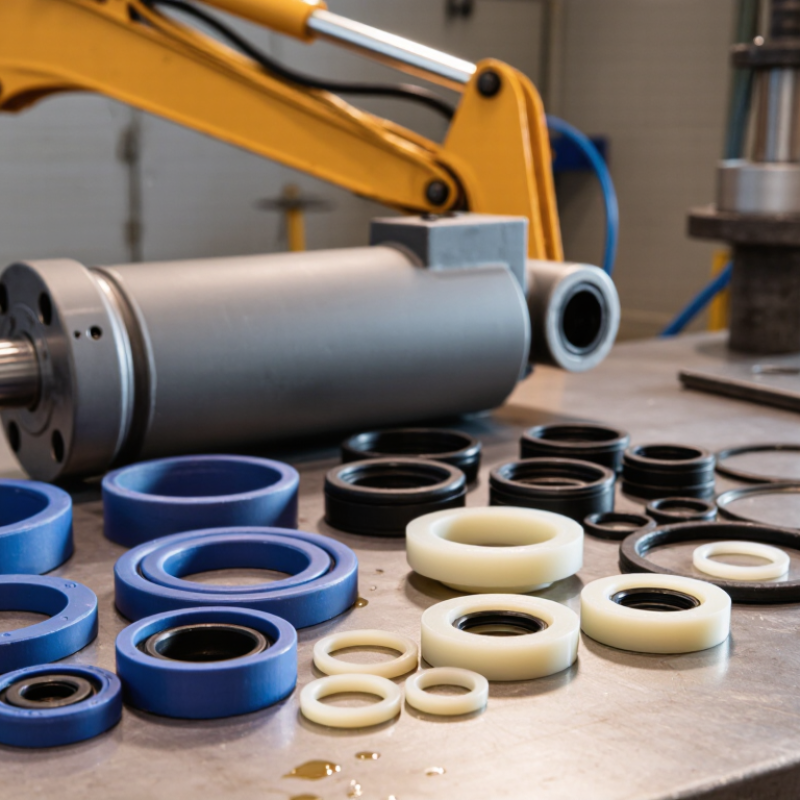
Hydraulic cylinder seals control fluid movement and maintain pressure inside the barrel. They also prevent external leakage around the moving rod. Rod seals manage high sliding friction at the cylinder opening. Piston seals separate pressure chambers and support efficient force transfer. Wipers remove mud, dust, and moisture before they reach sensitive components. Guide rings reduce side loading, while static seals protect fixed joints. Each seal has a specific task. No seal lasts forever.

Construction excavators, agricultural machinery, forklifts, presses, and refuse compactors use these sealing systems daily. Material selection depends on pressure, temperature, fluid type, and movement speed.

Polyurethane often handles demanding dynamic service. PTFE suits low-friction applications. Nitrile rubber performs well with many mineral oils, while fluorocarbon compounds tolerate higher temperatures. These choices are not interchangeable.

A seal that works well in a factory may fail quickly in a cold outdoor environment.

Field inspections often reveal scoring on the rod, hardened sealing lips, or fine dust packed behind the wiper. A small scratch can create a visible oil trail within hours. Incorrect installation is another common cause, especially when a seal twists inside its groove. Technicians should clean the housing, check groove dimensions, and use compatible assembly lubricant. Sometimes, leakage is blamed on the seal alone. That diagnosis can be wrong. Misalignment, excessive pressure, or contaminated fluid may be the real problem.

How to Evaluate Hydraulic Cylinder Seal Manufacturers

Evaluating hydraulic cylinder seal manufacturers requires more than comparing prices. I start with application details: pressure, temperature, rod speed, fluid type, and duty cycle. A serious manufacturer should ask these questions before recommending a seal profile. That conversation reveals technical experience.

Inspect material control closely. Reliable suppliers should provide compound specifications, batch traceability, and clear dimensional tolerances. Ask for test data covering extrusion resistance, wear, compression set, and low-temperature performance. Real test conditions matter. A laboratory result means little if it ignores the cylinder’s actual pressure peaks. I also request production samples and measure them with calibrated tools. Small defects can become visible leaks after thousands of cycles.

Factory experience should appear in more than polished brochures. Look for engineers who can explain groove design, surface finish, installation limits, and failure analysis. Ask whether they have investigated damaged seals from comparable equipment. Their answer should include photographs, measurements, and corrective actions, not vague promises. Certifications may support credibility, but they do not replace process evidence. I have learned that response speed can be revealing. Delayed technical replies often signal weak support, although this judgment is not always fair. A practical trial remains necessary. Test seals in representative cylinders, record leakage, friction, and temperature, then review the results with the manufacturer.

Global Market Overview of Hydraulic Cylinder Seal Production

Top 10 Hydraulic Cylinder Seals Manufacturers Worldwide

Global hydraulic cylinder seal production is expanding with construction, agriculture, mining, and industrial automation. Grand View Research estimates the global hydraulic seals market could grow at approximately 5% annually through 2030. Its analysis links demand to compact machinery, higher operating pressures, and longer maintenance intervals.

MarketsandMarkets reports that Asia-Pacific represents a major production and consumption region. China, Japan, South Korea, and India benefit from strong equipment manufacturing networks and extensive replacement demand. Europe remains important for engineered sealing systems, especially where temperature control and leakage prevention are critical. North America continues investing in industrial machinery and mobile hydraulic equipment.

Production quality depends on more than volume. Manufacturers must control polymer formulation, molding accuracy, surface finish, and dimensional stability. A seal may look flawless but fail after repeated pressure cycles. That detail is often underestimated. Industry studies also show growing interest in polyurethane, fluorocarbon, and advanced thermoplastic compounds. These materials can improve abrasion resistance and chemical compatibility.

The top ten global producers are not ranked permanently. Market positions change with capacity, certification, local supply chains, and custom engineering capabilities. Report boundaries also differ. Some studies measure complete hydraulic seals, while others include pneumatic and mechanical sealing products. This creates imperfect comparisons, and buyers should verify production data directly. Temperature ranges, pressure ratings, installation conditions, and tested service life deserve closer attention than advertising claims.

Top 10 Hydraulic Cylinder Seal Manufacturers Worldwide

The top 10 hydraulic cylinder seal manufacturers worldwide are usually judged by performance, consistency, and engineering support. Their products must withstand pressure, heat, abrasion, and repeated movement. A seal may look simple, but its profile controls leakage, friction, and service life.

Leading manufacturers typically offer rod seals, piston seals, wipers, guide rings, and static seals. They use polyurethane, nitrile rubber, fluorocarbon compounds, and engineered thermoplastics for different working conditions. Strong suppliers also provide dimensional drawings, material data, and application guidance. Testing often includes pressure cycling, temperature exposure, extrusion resistance, and wear evaluation. Real experience matters here. A seal that performs well in a clean workshop may fail quickly in muddy construction equipment.

Manufacturers serving mining, agriculture, lifting, and industrial machinery need dependable quality control. Batch traceability helps identify material or molding problems before installation. Fast technical responses are also valuable when a cylinder operates outside normal specifications. However, no global ranking remains perfect. Prices, delivery times, regional support, and customer requirements can change the order. I would examine independent test evidence instead of trusting polished claims. Small design details matter. A groove that is slightly incorrect can create early leakage. The best manufacturer is not always the largest; it is the one that matches the seal compound, profile, and operating environment accurately.

Industry Trends Shaping Hydraulic Cylinder Seal Manufacturing

The global market for hydraulic cylinder seals is changing beyond simple cost competition. Top manufacturers worldwide now focus on reliability, material science, and measurable field performance. Field experience shows that seal failure often begins with heat, contamination, or incorrect installation. Small leaks matter. They increase energy loss and can damage nearby components.

Advanced compounds are becoming central to product development. Polyurethane, engineered rubber, and protective blends must withstand pressure spikes and abrasive particles. Manufacturers are also reducing friction to improve efficiency in mobile and industrial equipment. Sustainability is influencing material selection, packaging, and production waste. However, greener materials do not automatically provide longer service life. That assumption needs careful testing.

Digital manufacturing is another strong trend. Automated inspection systems can detect tiny surface defects before shipment. Production records now connect batch data with test results, improving traceability and customer confidence. More buyers request seals designed for specific temperatures, fluids, and duty cycles. Standard products still have value, but they cannot solve every field condition. Predictive maintenance is expanding as sensors monitor leakage, pressure, and operating temperature. Yet sensor data can mislead when installation quality is ignored. Manufacturers must combine laboratory evidence with practical service feedback, not rely on software alone.

Top 10 Hydraulic Cylinder Seals Manufacturers Worldwide — Industry Trends Shaping Hydraulic Cylinder Seal Manufacturing

The chart presents the projected growth index for the global hydraulic seals market from 2024 to 2030, using 2024 as the baseline of 100. The values are calculated from a reported compound annual growth rate of approximately 5.1%. Key manufacturing trends include greater use of polyurethane and PTFE compounds, tighter leakage control, automated inspection, predictive maintenance, and improved energy efficiency.

Data note: Indexed values are calculated from the published industry CAGR outlook and do not represent sales, market share, or performance data from any individual company or brand.