
Discover Exciting Plastic Manufacturing Jobs at Allied Plastics

Who Are the Top Power Rail Insulator Manufacturers in China?

China has a broad supply base for Power Rail Insulator products, serving metro, railway, and industrial systems. Yet a long manufacturer list does not tell buyers which products suit a specific line. Material, geometry, operating voltage, pollution, and installation conditions all matter. A ceramic unit beside an exposed track faces different demands from a polymer insulator inside a protected station.

This guide compares leading Chinese manufacturers through practical purchasing questions. It considers product range, manufacturing capability, quality documentation, customization, and after-sales support. Readers should also check test reports and confirm that product specifications match their project requirements. Catalog photographs help, but they cannot show performance under years of vibration, moisture, dust, and temperature changes.

For technical perspective, Professor Ravi S. Gorur is known for research on electrical insulation and insulator performance. A cautious paraphrase of the engineering principle relevant here is: “Judge insulation under real service conditions, not by catalog claims alone.” This is not presented as a verbatim quotation. The distinction matters. A supplier may appear strong on paper, while a small detail—such as mounting dimensions or pollution resistance—can affect suitability. No shortlist replaces technical review. The comparisons that follow aim to help readers ask better questions, rather than promise a universal winner.
Who Are the Top Power Rail Insulator Manufacturers in China?

What Power Rail Insulators Are and How They Function

Power rail insulators separate energized conductors from supporting structures while keeping the rail correctly positioned. They help prevent current from reaching steelwork, fasteners, or nearby equipment. Many are molded from electrical-grade polymers, though material choice depends on voltage, temperature, contamination, and mechanical load. The shape matters, too. Ribs and extended surfaces can lengthen the path electricity must travel across an insulator, reducing the risk of leakage in damp or dusty conditions.

That path matters. A part may look sound but still be damaged by hairline cracks, loose fittings, or surface tracking. During inspection, technicians typically check for discoloration, chipped edges, water deposits, and unusual movement under vibration. These details can reveal trouble before a visible failure occurs. Clearances and mounting torque should follow the system design, not guesswork. There is no perfect insulator for every route; a choice that works in a dry indoor tunnel may perform poorly near salt spray or industrial dust. Even careful specifications can miss local conditions. Regular checks help connect laboratory ratings with what the rail actually faces in service.

Main Types of Insulators Used in Power Rail Systems

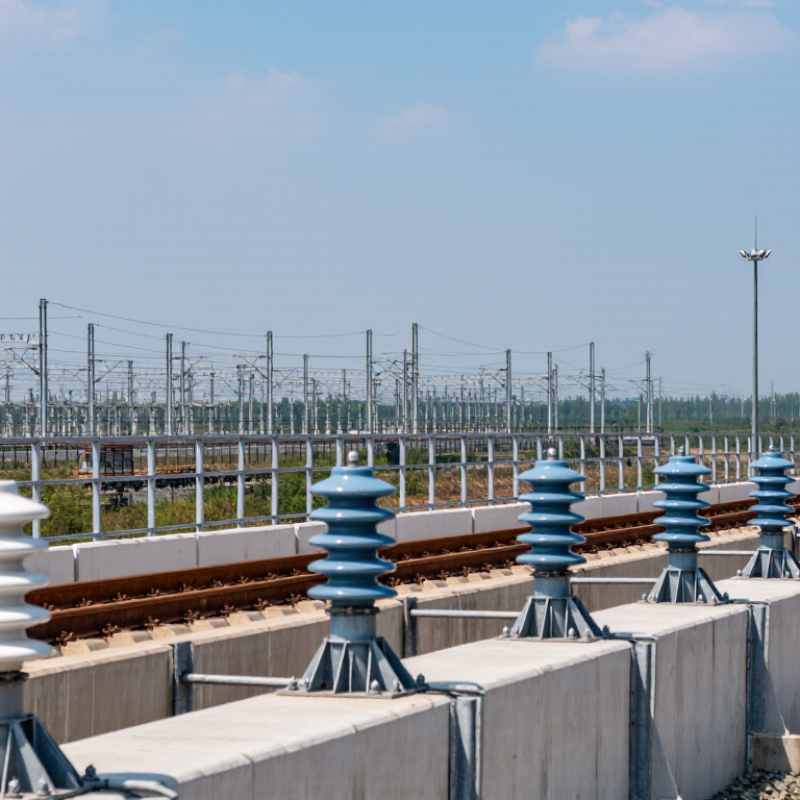
Power-rail systems use different insulators depending on whether current is carried overhead or beside the track. Overhead contact lines commonly use porcelain, toughened glass, or silicone-rubber composite insulators. Porcelain withstands heat and weather, but its weight can complicate installation. Glass makes surface damage easier to spot. Composite units are lighter, and their silicone sheds help water bead and run off in polluted or wet locations.

For third-rail systems, compact support insulators separate the energized rail from its steel or concrete supports. Epoxy or other polymer designs are common, but material alone does not determine service life. Engineers also assess creepage distance, mechanical loading, tracking resistance, and exposure to dust, salt, and cleaning chemicals. A small crack matters. Yet field conditions are not always captured by laboratory tests; inspection records still matter.

China’s 2023 Statistical and Analysis Report on Urban Rail Transit, published by the China Association of Metros, recorded 10,165.7 km of operating urban rail lines nationwide. That scale makes maintenance choices consequential, though the figure does not indicate how many insulators are installed. IEC 62217 outlines tests for polymeric high-voltage insulators, while IEC 60383 covers ceramic and glass units. These standards offer useful technical reference points; rail designers still need to match each type to its voltage, mounting geometry, and local contamination conditions.

Who Are the Top Power Rail Insulator Manufacturers in China? - Main Types of Insulators Used in Power Rail Systems

Insulator Type Common Materials Typical Location Primary Function Key Selection Considerations
Third-rail support insulator Porcelain or polymer composite Between the third rail and its supporting brackets or sleepers Supports the conductor rail and electrically isolates it from the track structure System voltage, mechanical load, clearance, contamination, moisture, and mounting arrangement
Overhead contact-line insulator Porcelain, toughened glass, or polymer composite Contact-line supports, cantilevers, and suspension assemblies Separates energized overhead conductors from poles and other grounded structures Electrical rating, creepage distance, mechanical strength, weather exposure, and fitting compatibility
Section insulator Insulating polymer or ceramic components with conductive fittings At boundaries between electrically separated overhead contact-line sections Allows a pantograph to pass while maintaining electrical separation between sections Line voltage, pantograph compatibility, operating speed, alignment, and wear performance
Traction substation support insulator Porcelain or polymer composite Busbars, switchgear, and other equipment in traction substations Supports energized conductors while insulating them from grounded equipment or structures Rated voltage, short-circuit forces, installation environment, dimensions, and connection hardware
Disconnect-switch insulator Porcelain or polymer composite Traction power switching and isolation equipment Insulates and supports switch components under normal operating and specified fault conditions Voltage and current ratings of the assembly, mechanical loading, pollution level, and interface dimensions
Feeder and cable termination insulator Polymer composite or porcelain, depending on the equipment design Connections between traction feeders, cables, and overhead or third-rail equipment Provides electrical insulation and mechanical support at conductor or cable interfaces Cable or conductor type, voltage rating, creepage distance, sealing, and installation conditions

How China’s Power Rail Insulator Manufacturers Are Assessed

Assessing China’s power rail insulator manufacturers starts with the duty conditions, not catalogue claims. The National Railway Administration’s 2023 railway statistics reported 159,000 km of operating railway and 45,000 km of high-speed railway. This scale makes consistent supply and documented quality important, but network length alone cannot prove a supplier’s capability. Buyers should match rated voltage, creepage distance, and mechanical load to the route’s design and local exposure. Rain, dust, salt, and temperature swings matter.

Test evidence deserves close scrutiny. Ask for dielectric withstand, impulse, mechanical-load, and environmental test results, with sample identification linked to production batches. Check whether an independent laboratory is accredited to ISO/IEC 17025, and whether its scope covers the tests presented. Inspect records for material formulation, molding, curing, and final inspection. IEC 60507 provides guidance for artificial pollution tests on ceramic and glass insulators; its relevance depends on the product and application. A neat certificate is not enough. Factory audits can reveal weak traceability or inconsistent process controls, though a brief visit may miss both. Even strong test results need field feedback, and that evidence is often incomplete.

Leading Manufacturers and Their Product Capabilities

Chinese power rail insulator manufacturers differ in materials, production scale, and engineering support. Some focus on porcelain or glass units, while others mold polymer insulators for lighter installations. The right choice depends on voltage, mounting space, pollution exposure, and mechanical load. Small details matter.

A capable supplier should explain its design basis, including creepage distance, interface dimensions, and expected cantilever strength. Ask for drawings, material specifications, and test records for electrical, mechanical, and environmental performance. Samples can reveal molding consistency, surface finish, and fit against the rail hardware. A catalog alone is not proof.

Manufacturing capabilities may include custom tooling, routine inspection, and controlled batch production. For outdoor systems, discuss moisture, temperature changes, and surface contamination rather than relying only on headline ratings. Also check how the supplier handles design revisions and traceability. These points can be easy to overlook. A low price may still leave unanswered questions about long-term performance, so technical documents and clear communication deserve close attention.

Power Rail Insulation: Thermal Class Ratings

Thermal class indicates the maximum operating temperature assigned to an electrical insulation system. The values shown are standard class ratings, not ratings for any particular manufacturer or product. Actual power rail limits depend on the complete design and operating conditions.

Reference: IEC 60085, Electrical insulation — Thermal evaluation and designation.

Applications and Key Factors in Choosing a Manufacturer

Power rail insulators keep live conductors separated from steel supports in metro depots, maintenance sheds, and factory handling systems. They help reduce leakage paths, resist vibration, and maintain clearance around moving equipment. In a depot, an insulator may face brake dust, oil mist, temperature swings, and repeated washing. Small defects matter.

China’s National Railway Administration reported about 159,000 km of railway in operation in 2023, with an electrification rate of 75.2%. That scale makes consistent component quality important. For rail applications, buyers should check rated voltage, creepage distance, mechanical load, and performance under moisture and pollution. Industrial power rails may need different designs, especially where cranes start and stop frequently or collect dust. The installation environment should guide the specification.

When comparing manufacturers, review type-test reports, production traceability, dimensional inspection records, and sample results—not just catalogue values. Ask how the supplier controls resin or ceramic batches, metal inserts, and curing or firing conditions. Confirm that test methods match the intended operating conditions and relevant technical standards. A neat sample is not enough. Site experience and clear failure-analysis procedures also matter. Some procurement teams overlook replacement access; that can turn a minor crack into costly downtime. I would verify that detail before approving a design.