Discover Exciting Plastic Manufacturing Jobs at Allied Plastics

Top 10 Plastic Board Types for Global Sourcing

Selecting the right plastic board begins with evidence, not attractive catalogue photos. Global demand is broad, but board performance varies sharply by polymer, thickness, density, surface finish, and manufacturing method.

The OECD’s Global Plastics Outlook reported 353 million tonnes of plastic waste worldwide in 2019. PlasticsEurope recorded approximately 400 million tonnes of global plastics production in 2022. These figures expose a practical sourcing issue: material volume does not guarantee responsible performance. A low-cost sheet may warp beside a sunny warehouse door, absorb moisture at a loading dock, or crack during winter transport.

This guide examines ten plastic board types used across construction, packaging, signage, furniture, industrial fabrication, and protective applications. The comparison considers impact strength, chemical resistance, machinability, temperature stability, recycled content, certifications, and supplier consistency. It also reflects factory experience: a technically suitable board can still fail when tolerances, packaging, or batch control are weak.

Steve Russell, former vice president of plastics at the American Chemistry Council, captured the circularity challenge clearly: “Plastics are too valuable to waste.” His point matters for global buyers. Recycled HDPE, polypropylene, PVC, ABS, acrylic, polycarbonate, and composite boards should be judged by verified specifications, not green claims alone.

Some assumptions deserve criticism. “Recyclable” does not always mean locally recyclable. “Food grade” does not replace application-specific compliance. Buyers need test reports, traceability, and realistic samples before placing volume orders. The best plastic board is not universally the cheapest or strongest. It is the one that remains reliable after production, shipment, installation, and repeated use.
Top 10 Plastic Board Types for Global Sourcing

Plastic Board Categories and Their Core Characteristics

Top 10 Plastic Board Types for Global Sourcing

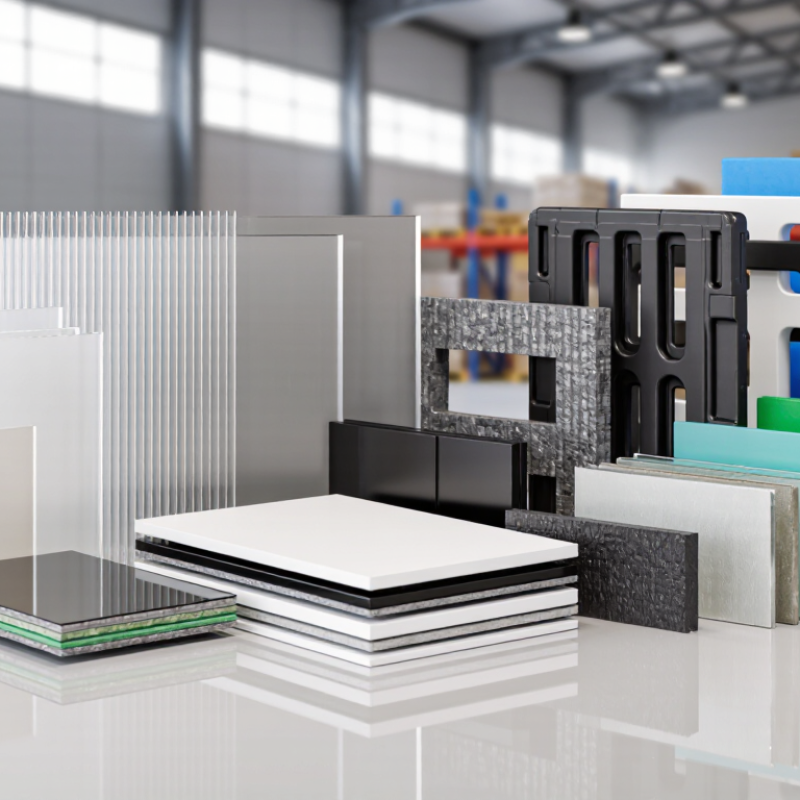
Plastic board categories differ sharply in strength, weight, weather resistance, and processing behavior.

High-density polyethylene offers low moisture absorption and reliable impact resistance for tanks, liners, and outdoor parts. Ultra-high-molecular-weight polyethylene adds exceptional wear resistance, though machining can be less predictable.

Polypropylene is lightweight and chemical resistant, but it may deform under sustained heat. Rigid PVC supports economical fabrication and insulation applications. PVC foam board is lighter, easier to route, and useful for interior panels.

Acrylic provides clear, glossy surfaces with good light transmission, yet it can crack under sudden impact. Polycarbonate is tougher and more impact resistant, although surface scratching remains a concern. ABS board balances stiffness, appearance, and machinability for housings and prototypes. PETG is easy to form and offers useful clarity, but heat resistance needs careful review. Nylon board handles friction and load well, while moisture absorption may change its dimensions.

Small differences matter.

For global sourcing, buyers should verify thickness tolerance, flatness, color consistency, and test methods before comparing prices. Requesting samples under actual temperature, load, and chemical conditions often reveals weaknesses hidden in datasheets.

A common mistake is choosing by density alone. It sounds simple. I have seen specifications that looked suitable until edge machining exposed internal stress.

Suppliers should provide batch records, technical data, and traceable inspection results. Standard compliance must also match the destination market and final application.

No single board type fits every project.
Key Performance Factors for Comparing Plastic Board Materials

Comparing plastic board materials for global sourcing requires more than checking price and color. Start with the working environment. Polyethylene boards usually offer strong moisture resistance, while polycarbonate boards provide higher impact strength. PVC boards can support rigid structures, but temperature limits and chemical exposure still matter.

Look beyond the polymer name. Measure stiffness, impact resistance, hardness, water absorption, and thermal expansion. A board may appear rigid in a warehouse, then bend under sunlight or machine heat. Ask for thickness tolerance and flatness data. Small variations can affect sealing, cutting, and assembly.

Surface behavior also deserves attention. Smooth boards clean easily, while textured surfaces may improve grip but collect dust. Check UV resistance for outdoor use. Confirm chemical compatibility with oils, solvents, and cleaning agents. Fire performance should match the project’s applicable requirements, supported by traceable test reports.

Do not trust a datasheet alone. Request samples from different production batches and test them under realistic loads. Compare drilling, sawing, bending, and edge finishing. Some materials machine beautifully but crack around fasteners. Others survive impact yet scratch too easily.

Cost calculations can also be incomplete. Include packaging, shipping volume, replacement rates, and machining waste. A cheaper board is not always economical. This point is easy to overlook. Supplier consistency matters as much as material performance, although perfect consistency is rarely realistic. Record the test conditions, because results without temperature, thickness, and loading details can create false confidence.

Top 10 Plastic Board Types for Global Sourcing - Key Performance Factors for Comparing Plastic Board Materials

Plastic Board Type Typical Density
(g/cm³)
Typical Tensile Strength
(MPa)
Approx. Continuous
Service Temperature
Impact Resistance Water Absorption
(24 h, typical)
Chemical Resistance UV / Weathering Machining & Fabrication Common Applications Key Sourcing Consideration
HDPE Board
High-density polyethylene
0.93–0.97 20–35 −50 to 80°C Excellent <0.01% Excellent against many acids, bases and salts; limited by strong oxidizers Fair unless UV-stabilized Easy to saw, route and weld; difficult to bond Tanks, cutting boards, wear liners, marine components, fabricated containers Specify grade, UV package, flatness, thickness tolerance and weldability
PP Board
Polypropylene
0.90–0.91 25–40 0 to 100°C Good; reduced at low temperatures <0.01% Very good against many acids, alkalis and solvents Poor to fair unless stabilized Easy to fabricate and heat-weld; low surface energy affects bonding Chemical tanks, laboratory furniture, ducts, packaging and process linings Check copolymer versus homopolymer, temperature range and low-temperature impact
Rigid PVC Board
Unplasticized polyvinyl chloride
1.35–1.45 40–55 0 to 60°C Fair to good; may become brittle in cold conditions 0.05–0.20% Very good against many acids, alkalis and salts Good for many outdoor grades; formulation-dependent Easy to cut, route, drill, weld and solvent-cement Signage, chemical tanks, ductwork, partitions and fabricated enclosures Confirm temperature, fire rating, chlorine content and regulatory requirements
ABS Board
Acrylonitrile butadiene styrene
1.03–1.07 35–50 −20 to 80°C Excellent 0.20–0.45% Good against dilute acids and alkalis; vulnerable to some solvents Poor to fair without stabilization Excellent machining and thermoforming; bonds readily with suitable adhesives Machine guards, housings, prototypes, interior panels and formed parts Request UV-stabilized or capped surface grades for outdoor use
Polycarbonate Board
PC
1.18–1.22 55–75 −40 to 115°C Exceptional 0.10–0.20% Good, but sensitive to some solvents and stress cracking Good when co-extruded or UV-treated; unprotected material can yellow Easy to machine and thermoform; control heat and residual stress Safety glazing, machine shields, impact guards, electrical covers and skylights Specify optical quality, UV side, fire rating, impact standard and protective film
PMMA Board
Acrylic / polymethyl methacrylate
1.17–1.20 60–80 −40 to 80°C Fair; lower than polycarbonate 0.20–0.40% Good against dilute acids and alkalis; vulnerable to solvents Excellent natural weatherability and optical retention Easy to cut, polish, machine and thermoform; avoid stress cracking Displays, glazing, light guides, signage, covers and architectural panels Prioritize light transmission, haze, color stability, surface finish and scratch resistance
PETG Board
Glycol-modified polyethylene terephthalate
1.27–1.30 45–60 −40 to 70°C Good to excellent 0.10–0.20% Good against many dilute chemicals; check solvent compatibility Fair to good; outdoor life depends on grade and exposure Excellent thermoforming, cutting and printing surface; easy to fabricate Point-of-purchase displays, guards, packaging, formed trays and cleanroom components Check forming window, food-contact documentation, clarity and thickness uniformity
POM Board
Acetal / polyoxymethylene
1.39–1.43 60–75 −50 to 100°C Good 0.15–0.25% Good against fuels, oils and many solvents; limited by strong acids Poor to fair unless UV-stabilized Excellent dimensional stability and precision machining Gears, bushings, rollers, guides, manifolds and precision machine parts Specify design clearance, grade, moisture conditions and flammability requirements
PTFE Board
Polytetrafluoroethylene
2.14–2.20 20–35 −200 to 260°C Good; low stiffness and creep must be considered <0.01% Outstanding chemical resistance across a very broad range Excellent Machinable but soft; difficult to bond and subject to creep Gaskets, seals, slide plates, chemical linings and high-temperature insulation Evaluate creep, compression, filler content, permeation and dimensional tolerances
UHMW-PE Board
Ultra-high-molecular-weight polyethylene
0.93–0.95 35–45 −100 to 80°C Exceptional <0.01% Excellent against many acids, bases and salts Poor to fair unless UV-stabilized Machinable, but low modulus and high wear can complicate precision work Wear strips, hopper liners, conveyor components, fenders and impact pads Compare wear rate, coefficient of friction, creep, UV package and thickness stability
Data note: The values shown are typical ranges for unfilled or standard commercial board grades. Actual performance varies with molecular weight, additives, fillers, processing method, thickness, temperature, loading and test standard. Request current technical data sheets and compliance documents before final sourcing.

Top 10 Plastic Board Types for Global Sourcing

Top 10 Plastic Board Types for Global Sourcing

Global sourcing teams often compare ten practical plastic board types: HDPE, LDPE, PP, PVC, PET, ABS, polycarbonate, nylon, acetal, and PTFE. Each grade suits a different working environment. HDPE handles moisture well and supports tanks, liners, and cutting surfaces. PP offers low density and strong chemical resistance. PVC remains useful for rigid panels and industrial partitions. PET provides dimensional stability, while ABS machines easily for protective housings. Polycarbonate resists impact, but scratches more readily than expected. Nylon and acetal support wear parts, although moisture can affect nylon’s dimensions. PTFE performs in demanding low-friction applications, but its cost requires careful justification.

The OECD Global Plastics Outlook reports that global plastics production reached 460 million tonnes in 2019, nearly double the 2000 level. It also recorded 353 million tonnes of plastic waste that year. These figures make material selection and end-of-life planning important purchasing decisions. Ask suppliers for resin identification, thickness tolerance, density, impact data, and test methods. ISO 178 flexural testing and ISO 527 tensile testing improve comparisons between factories. Request production samples.

Do not trust a perfect datasheet.

A board can pass laboratory testing yet warp during ocean transport, machining, or outdoor exposure. I have seen low-cost sheets create higher costs through rejected parts and delayed tooling. Recycled content may reduce environmental impact, but consistency varies by source. Country-specific customs rules, certificates, and packaging requirements also need verification before purchase. A written inspection plan protects quality better than a low unit price.

Top 10 Plastic Board Types for Global Sourcing

The chart compares representative density values for ten widely sourced plastic board materials. Density is shown in grams per cubic centimeter and may vary by grade, additives, reinforcement, and manufacturing process. These materials are commonly selected for industrial fabrication, construction, packaging, electrical insulation, and engineering applications.

Supplier, Certification, and Quality Assessment Criteria

Top 10 Plastic Board Types for Global Sourcing

Plastic boards differ sharply in strength, chemical resistance, machinability, and heat performance. Common options include HDPE, UHMWPE, PP, PVC, ABS, PC, PETG, acrylic, nylon, and phenolic boards. Supplier evaluation should begin with traceable material data, not attractive samples. Plastics Europe reported global plastic production of 400.3 million tonnes in 2022. This scale increases the risk of inconsistent batches and unclear recycled content.

Ask suppliers for certificates covering ISO 9001 quality systems and ISO 14001 environmental management. Request recent test reports for thickness tolerance, tensile strength, impact resistance, and water absorption. ASTM or ISO test methods should appear clearly on each report. For regulated applications, verify applicable REACH, RoHS, food-contact, or fire-performance documentation. OECD reported that only 9% of plastic waste was recycled globally in 2019. Therefore, recycled-content claims need batch records and independent verification. A certificate is evidence, not proof.

Tips: Compare three production batches. Measure thickness at several points. Check samples after heat and chemical exposure. Review calibration dates for testing equipment. Confirm whether the certificate belongs to the factory or a trading company. A polished audit file can still hide weak process control. No checklist is perfect. Leave room for site visits, failed samples, and uncomfortable questions. Supplier claims should match physical evidence, especially for boards used outdoors, under load, or near heat.

How to Select the Right Plastic Board for Your Application

Top 10 Plastic Board Types for Global Sourcing

How to Select the Right Plastic Board for Your Application

Selecting plastic board should begin with the working environment, not the material name. HDPE and UHMW-PE suit wear-resistant liners, cutting surfaces, and chemical handling areas. Polypropylene performs well around moisture and many industrial chemicals. PVC is practical for rigid panels, ducts, and general fabrication, but temperature limits require careful checking.

Acrylic offers clear, attractive surfaces, while polycarbonate provides stronger impact resistance. ABS is useful for housings and formed parts. PETG combines clarity with easier fabrication. Nylon handles mechanical loads, although it can absorb moisture and change dimensions. PEEK supports demanding heat and chemical conditions, but its cost may exceed the project value. I have seen buyers select by price alone, then replace boards after warping or cracking. A clean datasheet does not remove application risk.

Tips: Check temperature, load, moisture, chemical contact, thickness, and machining method. Ask for test data from the actual grade. Confirm tolerances before cutting. Compare total service cost, not only the purchase price. Small samples help, but they may not reveal long-term creep. Review fire performance and local compliance requirements with a qualified engineer. Also inspect packaging and surface protection during international transport. Mistakes happen there too.