Discover Exciting Plastic Manufacturing Jobs at Allied Plastics

Top Thick Plastic Rolls for Packaging Buyers

Choosing packaging film is not as simple as picking the thickest option. A thick plastic roll may resist punctures and handle heavier loads, but thickness alone does not guarantee reliable protection. The right choice depends on what you are wrapping, how it will be stored, and how it will move through your packing line. A roll used for sharp-edged parts has different demands from one covering cartons or bundling pallet loads. Details matter.

This guide helps packaging buyers compare roll thickness, width, material, and core size against real handling needs. Check whether the film stretches evenly around corners, clings securely, and unwinds without excessive effort. For outdoor storage, ask the supplier whether the material is suitable for the expected exposure; ordinary film may not hold up well in direct sun. Request product specifications and, where practical, test a sample with your actual products. Small trials can reveal problems that a product sheet cannot.

Also consider roll weight, dispenser compatibility, and how much film each job consumes. A heavier roll may reduce changeovers, yet strain a manual dispenser or become awkward to handle. There is no perfect specification for every buyer. It is easy to overvalue thickness and overlook application. Compare the film’s performance, not just its gauge or price, and confirm that the supplier can provide consistent specifications across repeat orders.
Top Thick Plastic Rolls for Packaging Buyers

What Thick Plastic Packaging Rolls Are and How They Are Made

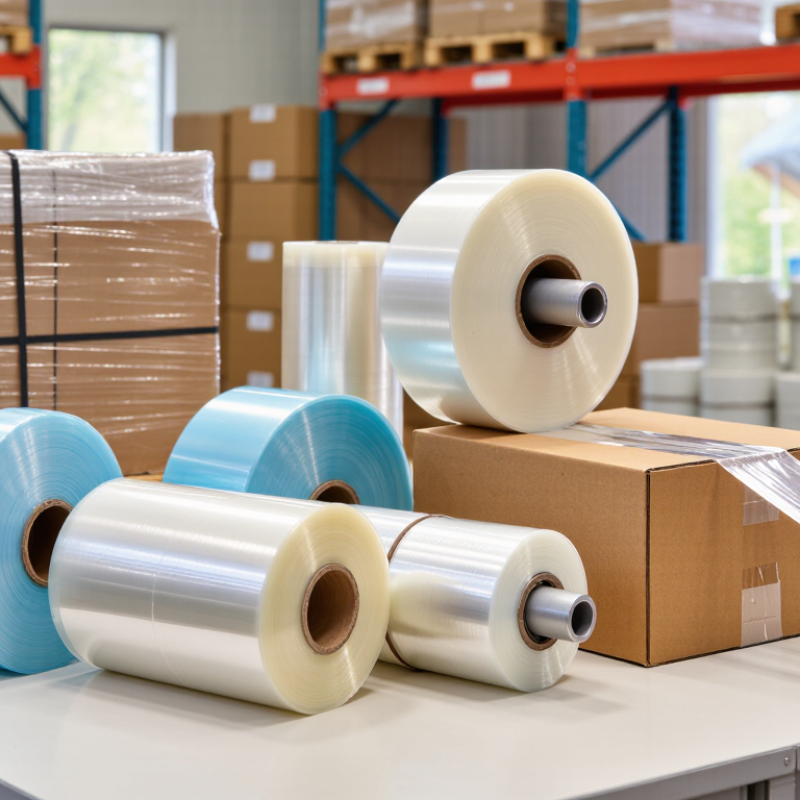
Thick plastic packaging rolls are continuous sheets wound around a core, ready for bag-making, wrapping, or lining. “Thick” has no universal cutoff; buyers usually compare measured gauge or microns against the load, sharp edges, and handling conditions. The detail matters. A heavier film may resist punctures, but it can add material, weight, and sealing challenges.

Most rolls begin as polymer pellets. Heat melts the resin, then an extruder pushes it through a circular die to form a tube. Air inflates the tube into a bubble; cooling sets the film before rollers flatten and wind it. Cast extrusion uses a flat die and chilled rollers instead. Some films combine layers, giving each layer a job, such as strength or moisture resistance. Production sounds tidy. It isn’t always.

The OECD’s Global Plastics Outlook reports that packaging represented about 31% of global plastics use in 2019. The Flexible Packaging Association’s 2023 State of the Industry report puts U.S. flexible-packaging sales at about $42.5 billion that year. These figures show the scale, not the ideal roll thickness for any one buyer. Ask suppliers for thickness tolerances and test data, such as tensile or puncture performance. ASTM D882 describes tensile testing for thin plastic sheeting, though a test result cannot predict every warehouse mishap. Thickness alone is not protection.


Materials, Thickness, Width, and Performance Features

Top Thick Plastic Rolls for Packaging Buyers

Material choice shapes how a thick plastic roll handles weight, moisture, and sharp corners. Low-density polyethylene is flexible and seals readily; linear low-density polyethylene often offers stronger puncture resistance at comparable gauges. Recycled-content films can reduce demand for virgin resin, but their consistency may vary. Check the supplier’s specifications and test the actual film.

The Flexible Packaging Association’s 2023 State of the U.S. Flexible Packaging Industry report put U.S. flexible-packaging sales at $42.9 billion in 2022. That figure covers many formats, not thick rolls alone, so it signals market scale rather than a buying forecast.

Thickness is commonly listed in mils; one mil equals 25.4 microns. More thickness can improve protection, but it may also raise material use and sealing demands. There is no perfect gauge. Width should match the product, machine path, and seal allowance; a roll that is too narrow can expose edges, while excess width creates waste.

Ask for tensile and tear data, not just a thickness claim. ASTM D882 measures tensile properties of thin plastic sheeting, but puncture testing may better reflect a rough, heavy load. A sample run helps. I would still review the results under real packing conditions, since lab tests cannot reproduce every snag, fold, or temperature change.

Common Types of Thick Plastic Rolls and Their Packaging Uses

Thick plastic rolls serve different packaging jobs, even when they look similar on a warehouse shelf. Heavy-gauge polyethylene sheeting is useful for covering large items, lining cartons, or wrapping furniture against dust and light moisture. It unfolds quickly over broad surfaces. For irregular loads, bubble cushioning rolls add a layer of impact protection around corners, glassware, and small equipment. Larger bubbles can cushion more, but they also take up extra storage space.

Thick stretch film is designed to bind cartons or products together on a pallet. Its cling helps hold a load steady during handling, while multiple layers can protect exposed surfaces from scuffs and dust. It is not a substitute for a rigid corner guard when boxes have sharp edges. Heavy-duty shrink film is another option for bundled goods or equipment; controlled heat tightens it around the load. Check that the item can tolerate the heat before using this method.

The right roll depends on load weight, shape, handling, and storage conditions. Thickness alone does not guarantee protection. Ask for the film’s measured gauge or micron value, then test it on a representative package. A small trial can reveal weak seams or awkward handling. It may feel slower at first, but it can prevent wasted material later.

How to Match Roll Specifications to Packaging Requirements

Top Thick Plastic Rolls for Packaging Buyers

Match the roll to the product, machine, and shipping conditions—not just the word “thick.” Confirm film gauge, roll width, core size, and maximum outside diameter against the packaging line. A roll that is too wide may wrinkle at the sealing jaws; an oversized roll may not fit the unwind stand. Small details matter. Specify resin type and sealing range too, since these affect flexibility, clarity, and reliable seals. A paper specification can still miss a real line problem.

For heavy or sharp-edged items, ask suppliers for puncture, tear, and tensile test results. ASTM D1709 measures impact resistance, while ASTM D1922 measures tear resistance. Compare results from the same test method; numbers from different methods are not directly interchangeable. The OECD’s Global Plastics Outlook (2022) reports that packaging accounts for about 40% of plastic waste. That is a reason to avoid unnecessary material, not a reason to reduce thickness blindly. Test a sample on your own line, then check seal quality and damage after handling.

Tips: Record the actual product weight, edge shape, drop or stacking conditions, and sealing temperature. Request a short trial roll. Watch for telescoping, uneven winding, or weak seals. Recheck the specification after the trial; real results can be messier than the first estimate.

Top Thick Plastic Rolls for Packaging Buyers - How to Match Roll Specifications to Packaging Requirements

Use these typical specification ranges as a starting point. Actual availability, strength, and suitability vary by resin, film construction, manufacturing process, and packaging conditions. One mil equals 0.001 inch, or 25.4 microns (µm).

Packaging requirement Common film material Typical thickness Common roll width Common roll length Specification considerations
Heavy-duty pallet overwrap Linear low-density polyethylene (LLDPE) stretch film 60–120 gauge (15–30 µm) 12–30 in (305–762 mm) 1,000–5,000 ft (305–1,524 m) Select for load weight, sharp edges, stretch method, and required load containment. Gauge alone does not determine performance.
Protective pallet hood or machinery cover Low-density polyethylene (LDPE) or LLDPE tubing/sheeting 4–10 mil (102–254 µm) 24–120 in (610–3,048 mm), lay-flat or slit width 100–1,000 ft (30–305 m) Confirm cover dimensions, closure method, puncture exposure, and whether the film must resist moisture, dust, or outdoor weather.
Industrial liners for bins, drums, or containers LDPE, LLDPE, or polyethylene blend 2–6 mil (51–152 µm) 18–72 in (457–1,829 mm), depending on roll format 100–1,000 ft (30–305 m) Match liner dimensions to the container and contents. Check seam strength, chemical compatibility, and food-contact requirements where applicable.
Construction or equipment protection sheeting LDPE or recycled-content polyethylene, where suitable 4–10 mil (102–254 µm) 10–40 ft (3.0–12.2 m), often folded on roll 50–200 ft (15–61 m) For outdoor use, verify UV-resistance claims and expected exposure duration. Consider tear resistance, coverage area, and handling conditions.
Thick protective wrap for parts and components LDPE or coextruded polyethylene film 3–8 mil (76–203 µm) 6–60 in (152–1,524 mm) 100–1,000 ft (30–305 m) Consider surface protection, foldability, transparency, and the risk of abrasion or puncture during storage and transit.
Moisture barrier for non-food industrial goods Polyethylene film or multilayer barrier film 4–12 mil (102–305 µm), depending on construction 12–60 in (305–1,524 mm) 100–1,000 ft (30–305 m) Specify the required moisture or gas barrier, seal method, and storage conditions. A thicker single-layer film is not automatically equivalent to a barrier laminate.

Buyer checklist: Confirm thickness and tolerance, roll width and length, core diameter, roll weight, winding direction, film type, color or clarity, recycled content, and any regulatory or performance requirements before ordering.

How to Compare Suppliers, Costs, and Storage Needs

Thick plastic rolls can vary widely in strength, even when their listed thickness looks similar. Compare thickness, width, roll length, core size, and material type against your packaging equipment and product weight. Ask suppliers how they measure thickness and what tolerance they allow. A sample run can reveal feeding problems or tearing that a specification sheet misses. Small details matter.

Compare quotes on usable output, not price per roll alone. Check freight, minimum order quantities, lead times, and whether the quoted dimensions match your requirements. Request a written specification and a sample when possible. For a fair comparison, test the same packaging task with each sample and record waste, handling time, and seal performance. I have found that small test runs are useful, though they cannot predict every production issue.

Tips: Store rolls in a clean, dry area, away from direct sunlight and heat. Keep them on a stable surface and follow the supplier’s stacking and handling guidance. Measure your storage space before ordering; wide rolls can be awkward to move through narrow doors. Check the fit. If stock will sit for months, ask about recommended storage conditions and shelf life.

Top Thick Plastic Rolls for Packaging Buyers

Compare suppliers, costs, and storage needs using a consistent roll specification.

Estimated film weight for a 1 m wide × 100 m long LDPE roll, using a density of approximately 920 kg/m³; core and packaging are excluded. Greater thickness means more material per roll, which can affect purchase cost and handling. Compare supplier quotes using the same material, thickness, width, and length. Actual storage space depends on roll diameter, core size, and pallet arrangement. These are calculated estimates, not supplier quotations.