Industrial plastics are not one material with one universal ranking. The right choice depends on temperature, load, chemical exposure, impact, and cost. That distinction matters. A clear plastic panel may suit a machine guard, while a low-friction component may need a very different polymer. Even familiar materials behave differently across grades and processing methods.
This guide introduces ten widely used industrial plastics: polyethylene, polypropylene, PVC, PET, polystyrene, polycarbonate, ABS, nylon, acetal, and PTFE. Each offers a distinct balance of properties. Polycarbonate is valued for impact resistance; PTFE performs well where low friction and chemical resistance matter. Nylon can handle demanding mechanical applications, but moisture may affect its dimensions. Details matter.
The list is a practical starting point, not a substitute for engineering review. A material that works in a dry, room-temperature setting may fail under sustained heat, vibration, or repeated chemical contact. Check the manufacturer’s technical data for the specific grade, and consider fabrication, joining, maintenance, and end-of-life needs. These factors can change the apparent winner. Some comparisons remain imperfect because product grades and test conditions vary. The sections ahead explain where each plastic is commonly used, what trade-offs to expect, and which questions to ask before specifying industrial plastics for a real application.
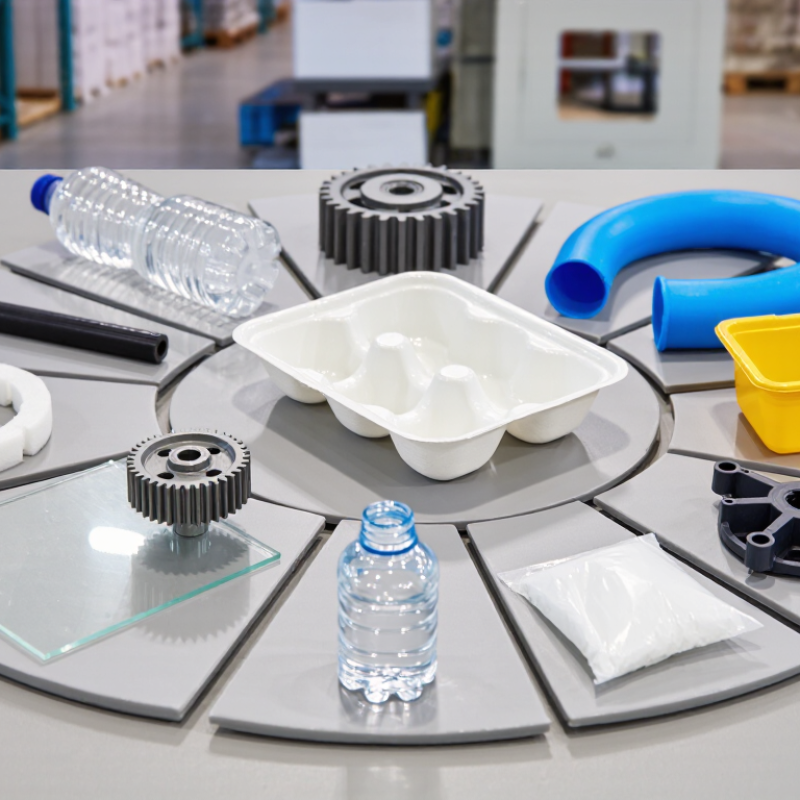
Industrial plastics are polymer materials chosen for repeatable performance in machinery, electrical systems, construction, and production equipment. The term describes a use, not one formally defined polymer family. A pipe fitting, gear, and cable insulator may all qualify. Their needs differ. Engineers commonly classify plastics by heat response: thermoplastics soften when heated, while thermosets cure into structures that do not melt again. Elastomers stretch and recover, making them useful for seals and vibration mounts. Materials are also compared by chemistry, strength, temperature tolerance, chemical resistance, and processing method.
PlasticsEurope reported 400.3 million tonnes of global plastics production in 2022, covering many sectors and material grades. This scale matters. The OECD’s 2022 Global Plastics Outlook estimated 353 million tonnes of plastic waste in 2019; only 9% was ultimately recycled. These figures describe the wider plastics system, not industrial plastics alone. For a meaningful comparison, name both the polymer and its grade: glass-reinforced polyamide, for example, behaves differently from unfilled polyamide. Classification charts help, but they can oversimplify. Moisture, additives, and part geometry may shift real-world performance, even when two components share the same polymer name.
| No. | Industrial Plastic | Classification | Key Characteristics | Common Industrial Uses |
|---|---|---|---|---|
| 1 | Polyethylene (PE) | General-purpose thermoplastic; commonly supplied as high-density PE (HDPE) and ultra-high-molecular-weight PE (UHMWPE). | HDPE is lightweight, moisture-resistant, and chemically resistant. UHMWPE offers especially high abrasion resistance and low friction. | Pipes, chemical tanks, containers, wear strips, liners, and conveyor components. |
| 2 | Polypropylene (PP) | General-purpose, semi-crystalline thermoplastic. | Low density, good chemical resistance, and good fatigue resistance; its properties depend on grade and temperature. | Industrial containers, chemical piping, pump components, packaging equipment, and living hinges. |
| 3 | Polyvinyl Chloride (PVC) | Thermoplastic available in rigid and flexible formulations. | Good resistance to many acids and alkalis; rigid grades provide stiffness, while plasticized grades are more flexible. | Pipes, fittings, cable insulation, ducts, tanks, and protective coverings. |
| 4 | Acrylonitrile Butadiene Styrene (ABS) | Engineering thermoplastic; generally amorphous. | Combines impact resistance, rigidity, and ease of fabrication; performance varies with formulation and environment. | Machine housings, instrument enclosures, protective covers, and equipment panels. |
| 5 | Polycarbonate (PC) | Engineering thermoplastic; amorphous. | High impact strength and transparency in suitable grades; can be sensitive to certain chemicals and stress cracking. | Machine guards, safety shields, lighting covers, and durable transparent components. |
| 6 | Polyamide (PA, commonly called Nylon) | Engineering thermoplastic; typically semi-crystalline. | Good strength, wear resistance, and fatigue performance; absorbs moisture, which can change dimensions and mechanical properties. | Gears, bearings, rollers, cable ties, and other moving machine parts. |
| 7 | Polyoxymethylene (POM, or Acetal) | Engineering thermoplastic; semi-crystalline. | Good dimensional stability, stiffness, low friction, and wear resistance; available in homopolymer and copolymer grades. | Precision gears, bushings, conveyor parts, valve components, and pump parts. |
| 8 | Polyethylene Terephthalate (PET) | Thermoplastic polyester; can be semi-crystalline or amorphous depending on processing and grade. | Good strength and dimensional stability; industrial grades are often selected for wear performance and machinability. | Electrical insulators, precision components, films, and machine parts. |
| 9 | Polytetrafluoroethylene (PTFE) | Fluoropolymer thermoplastic; semi-crystalline. | Very low friction and broad chemical resistance; it is not melt-processed by conventional injection molding methods. | Seals, gaskets, chemical linings, sliding bearings, and electrical insulation. |
| 10 | Polyether Ether Ketone (PEEK) | High-performance engineering thermoplastic; semi-crystalline. | Retains useful mechanical properties at elevated temperatures and resists many chemicals; substantially more costly than commodity plastics. | High-performance bearings, pump and valve parts, electrical components, and demanding industrial equipment. |
Classification and performance can vary by grade, additives, processing method, and operating conditions. Confirm a material’s datasheet and chemical compatibility before specifying it for an application.